Classical School-
Modern Followers- Adam Smith, Alfred Marshall, JB Say, David Ricardo
Say's Law- Supply always creates its own demand.
Production=income=spending; under spending is unlikely
Whatever output produced will be demanded.
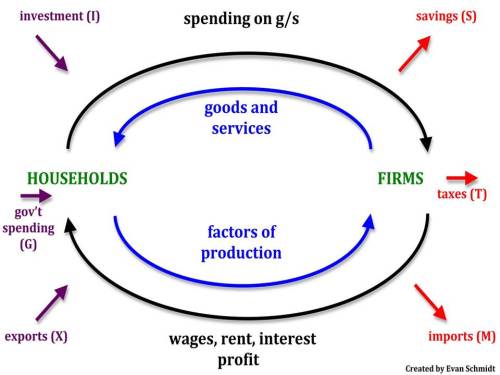
Savings= Investment income, Saving(leakage)= Investment(Injection)
Competition good
Government-
Invisible Hand- Govt/econ. can regulate self
Monetary rule
maintains steady money supply
Laissez-Faire
Economy-
Economy self regulating
In long run, economy will balance at full employment.
Economy is always close to or full employment
Unemployment rarely exists due to wage, price flexibility
Prices, wages are flexible downward
Support trickle-down effect (rich first, everyone else second)
Supply curve- Vertical
AS determines output, employment
AD determines price level, reasonably stable if money supply is stable.
MV=P*Q
SRAS is short, Emphasis today in Microeconomics
Keynesian School-
Competition flawed
AD is key, not AS
Leaks and savings cause recession
Government
Fiscal Policy- Tax and spend
Believe in active government
Economy is no self-regulating
Economy
C+Ig+G+Xn=GDP
AD determines output and employment
Ratchet effects+ Sticky wages block Say’s Law.
Prices and wages inflexible downward
Unemployment usually exists, caused by external and internal
Inflation is caused by too much demand
SRAS is long, Emphasis today in macroecnomics. In long run, we are dead.

Don't forget about the intermediate range! In the intermediate range (between the Keynesian and classical) the price is flexible, wages are fixed, the employment level is flexible and the output depends upon changes in price and employment levels.
ReplyDelete